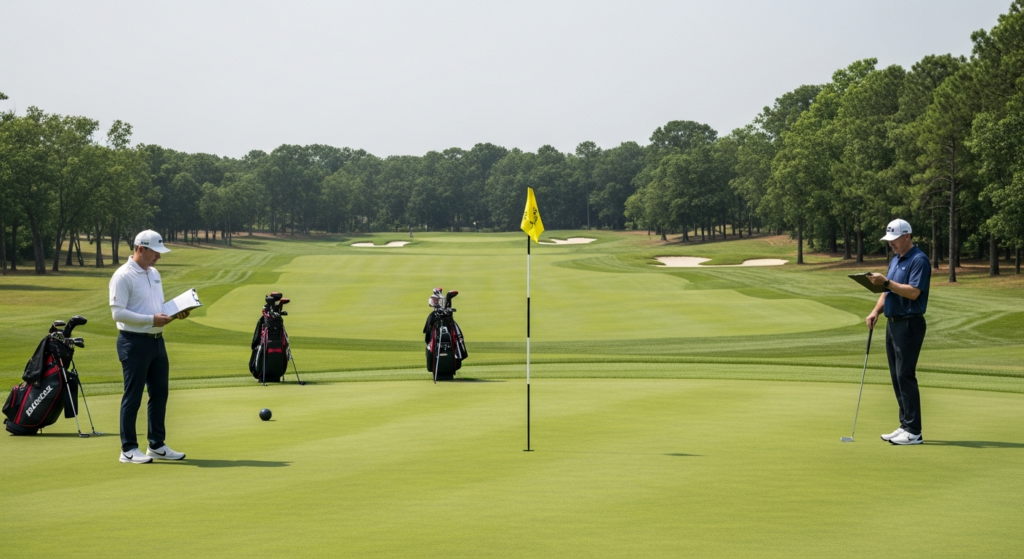
A foundational guide to golf etiquette, last revised in March 2013, outlines a comprehensive set of practices designed to improve player enjoyment, ensure safety, and maintain the pristine conditions of golf courses. The manual serves as a resource for both seasoned golfers and newcomers, emphasizing the shared responsibility of all players in upholding the sport’s traditions and operational standards.
One of the primary areas addressed is appropriate attire. The manual advises golfers to consult specific course dress codes in advance, as policies can vary. Generally, collared shirts and slacks are considered suitable, while garments such as jeans, tank tops, short shorts, and T-shirts are typically discouraged. This guidance extends to clubhouse conduct and golf-shop check-in procedures, setting a tone for respectful engagement from arrival.
Beyond dress, the manual details conduct during play. It instructs players to remain motionless and quiet when others are making strokes, fostering an environment of concentration and respect. Maintaining composure, avoiding abusive behavior, and refraining from foul language are also underscored as essential for a positive experience for all participants. Cell phone policies, while varying by course, generally recommend keeping devices on vibrate mode to minimize disruption.
Pace of Play and Course Flow
Pace of play is a critical component of golf etiquette, directly impacting the flow and enjoyment for all groups on the course. The manual suggests that most 18-hole courses can be completed in four hours or less by a group of four, provided that groups maintain an appropriate pace. To achieve this, players are encouraged to arrive early enough for preparation, typically allowing five to 15 minutes before their tee time. During play, groups are expected to keep within a shot of the group ahead. If a group falls behind, the manual directs them to invite following groups to play through, ensuring that the course does not become congested.
Practices like “ready golf,” where players hit when ready rather than strictly adhering to farthest-out first, are recommended to expedite play. Limiting practice swings and promptly leaving the green after holing out also contribute to maintaining a good pace. When a shot may be out of bounds or lost outside a water hazard, players are advised to hit a provisional ball immediately to avoid delays. The manual also sets a five-minute limit for searching for a lost ball, after which it should be abandoned.
Safety Protocols on the Course
Safety is paramount on any golf course, and the manual provides clear guidelines to prevent accidents. Golfers are required to ensure that no one is within range of their club swing before taking a shot. Similarly, players must wait until those ahead are well out of range before hitting their own ball. In instances where a ball in motion might strike someone, the manual instructs golfers to shout “FORE!” loudly and clearly to alert individuals in harm’s way.
Course Maintenance and Responsibility
Player responsibility extends to the meticulous care of the course itself. The manual directs golfers to replace divots, rake bunkers to smooth footprints and club marks, and repair ball marks on the greens. Avoiding damage to greens and holes, particularly around the cup, is emphasized. Adherence to cart policies, such as the 90-degree cart rule or restrictions to cart paths, is also crucial for preventing turf damage. When carts are restricted to paths, players are advised to take multiple clubs to their ball to avoid unnecessary trips back to the cart.
Understanding Golf Terminology and Rules
An understanding of basic golf rules and terminology is essential for all players. The manual defines several key terms that govern play and course conditions:
* Bunker: A hazard consisting of a prepared area of ground, often a hollow, from which turf or soil has been removed and replaced with sand or the like. A ball is considered in a bunker when any part of it touches the bunker.
* Casual Water: Any temporary accumulation of water on the course that is not in a water hazard and is visible before or after the player takes a stance. A ball is considered in casual water when any part of it touches the water.
* Ground Under Repair (GUR): Any portion of the course so marked by an authorized committee or as defined by local rules. This includes material piled for removal and holes made by greenkeepers. A ball is considered in ground under repair when any part of it touches the area.
* Line of Putt: The line that the ball is expected to take after a stroke on the putting green. Players must not walk on or otherwise damage another player’s line of putt.
* Out of Bounds: Ground on which play is prohibited. A ball is out of bounds when all of it lies out of bounds.
* Putting Green: The area of the hole being played that is specially prepared for putting. A ball is considered on the putting green when any part of it touches the green.
* Stroke: The forward movement of the club made with the intention of striking at and moving the ball.
* Teeing Ground: The starting place for the hole to be played. It is a rectangular area two club-lengths deep, the front and sides of which are defined by the outside limits of two tee-markers.
* Through the Green: The whole area of the course except the teeing ground and putting green of the hole being played and all hazards on the course.
By familiarizing themselves with these definitions and the broader principles of etiquette, golfers can contribute to a more enjoyable and orderly experience for everyone on the course.
Why it matters in Hilton Head Island
For Hilton Head Island, a community deeply intertwined with the sport of golf, adherence to these etiquette guidelines is particularly significant. The island boasts numerous world-class golf courses, including those at Sea Pines Resort and other major plantations, which are central to its identity and economic vitality. Maintaining these courses in pristine condition and ensuring a smooth, respectful playing environment directly supports the island’s reputation as a premier golf destination, attracting millions of visitors annually. The principles outlined in the manual help preserve the quality of play and the overall experience, which in turn sustains the hospitality and tourism sectors that are major employers for residents of Hilton Head Island and Beaufort County.