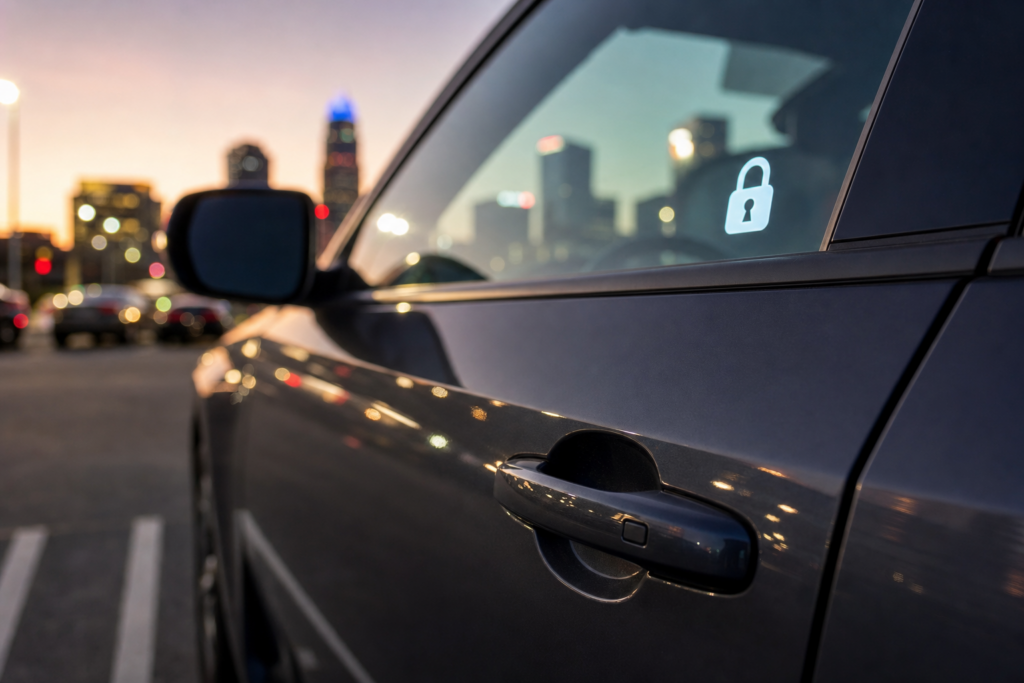
It sounds almost too simple: lock your doors, don’t leave things visible inside your car. Yet according to the FBI’s Uniform Crime Report, motor vehicle theft and related larceny-from-vehicle offenses account for hundreds of thousands of incidents every year across the United States — and a significant share of those involve unlocked vehicles or items left in plain sight. The National Insurance Crime Bureau (NICB) has tracked this pattern for decades and consistently finds that the most targeted vehicles share one trait: they made it easy for a thief. The steps below don’t require expensive equipment. They require consistent habits.
Lock Your Doors — Every Single Time
This seems obvious, but FBI UCR data and NICB annual reports both show that a meaningful percentage of vehicle break-ins and thefts involve unlocked vehicles. Modern thieves often work a parking lot or residential street methodically: they try door handles one by one and move on to unlocked cars. The walk back is a moment when it’s easy to forget to hit the lock button, especially if you’re carrying bags or distracted. Make it a non-negotiable habit: lock the moment you step out, every time, regardless of how briefly you plan to be away from the vehicle.
Also check that your windows are fully closed. A cracked window doesn’t just allow access with a slim jim — it signals that the driver may be careless and worth a second look.
Don’t Leave Valuables Visible
The NICB consistently reports that items left in plain view are the primary trigger for smash-and-grab break-ins. Thieves don’t need to know what’s in a bag — they just need to see a bag. The same applies to:
- Laptops, tablets, and phones on seats or floorboards
- Purses, backpacks, and gym bags
- Charger cables and charging adapters (a visible cable implies a device is nearby)
- Loose change in cup holders and door pockets
- Sunglasses, headphones, or earbuds left on the seat
- Shopping bags and retail packaging
If you must leave something in the car, put it in the trunk before you arrive at your destination — not after you park. A thief watching a parking lot will see you move items to the trunk and know they’re there. Move items to the trunk at your previous stop.
Where You Park Matters
Lighting and visibility are significant deterrents. Park in well-lit areas whenever possible, especially at night. Covered, attended parking structures tend to have lower break-in rates than remote surface lots. When parking on a residential street in Hilton Head Island, choose a spot with good sightlines from nearby homes or businesses rather than a dark, isolated stretch. Avoid parking for extended periods near known high-theft corridors — your local police non-emergency line can tell you which areas in Hilton Head Island see the highest vehicle break-in activity.
If you drive a model that appears frequently on NICB’s most-stolen vehicle lists, consider an additional deterrent: a visible steering wheel club lock, a dashboard camera with a parking mode that records motion, or an aftermarket alarm with a visible indicator light. These add minimal cost but measurable deterrent effect.
Secure Your Registration and Insurance
Don’t leave your vehicle registration or insurance card loose in the glove box — they contain your home address, which is useful to a thief who wants to know when your house might be empty. Use a small lockable glove box insert, or store digital copies through your insurer’s app and keep only photocopies with your address redacted in the car. Check your state’s South Carolina requirements for what documents must be kept in the vehicle.
Anti-Theft Technology Worth Considering
Modern vehicles often include factory security systems, but aftermarket tools can add layers:
- GPS trackers: Compact, battery-powered devices tucked in a hidden location allow recovery teams and police to locate a stolen vehicle quickly. The NICB actively supports vehicle recovery operations and encourages owners of high-value or high-risk vehicles to use tracking devices.
- Dashcams with parking mode: These record motion or impact while the car is off and can capture a perpetrator’s face and vehicle on camera.
- VIN etching: Etching your vehicle identification number onto windows reduces resale value for parts, deterring professional theft rings. Some insurers in South Carolina offer a small premium discount for etched vehicles.
What to Do If Your Car Is Broken Into
- Don’t touch anything before calling the police if you want prints collected — though in practice, most jurisdictions won’t dust a car for prints on a smash-and-grab.
- Call your local police non-emergency line and file a report. You’ll need a case number for insurance.
- Document everything. Photograph the damage, photograph the interior, and write down every item that was taken with its approximate value.
- Call your insurer. Comprehensive auto coverage typically covers theft of personal property from a vehicle, though your homeowner’s or renter’s policy may cover personal belongings at a lower deductible — check both.
- Change digital passwords if any device containing saved passwords was taken. Remote-wipe phones and laptops immediately if you have that capability enabled.
Vehicle break-ins are crimes of opportunity. In Hilton Head Island as anywhere, the majority of perpetrators are looking for the easiest possible target. Locked doors, empty seats, good lighting, and a visible deterrent are enough to move a thief along. These habits cost nothing. Make them automatic.