Editor’s Disclosure
HEREHiltonHead.com is published by HERECity Network, an independent local news organization. Your Indoor Golf Solutions, the subject of this article, has a business relationship with HERECity Network as a technology and services partner. This article was reported, written, and edited by a HERE editor to HERECity Network’s editorial standards. Your Indoor Golf Solutions reviewed the article for factual accuracy regarding its own business operations only; editorial judgment and final publication decisions rest with HERECity Network. See our Editorial Standards.
The corporate retreat used to mean a rented conference room, a working lunch, and maybe a round of mini golf if someone felt generous. On Hilton Head, where resorts and corporate groups already compete for the same event calendar, that formula is getting a quiet upgrade.
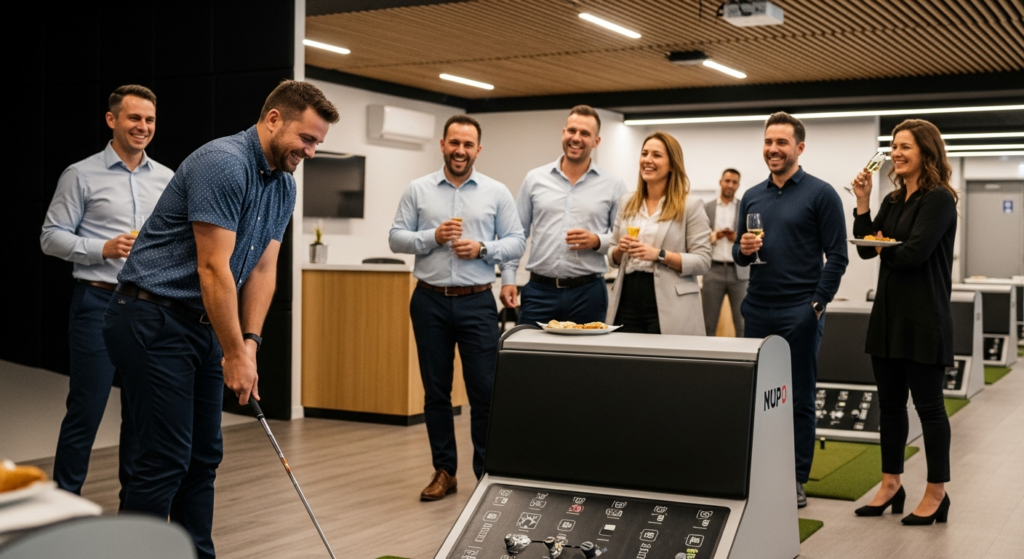
Golf simulator bays have become one of the fastest-growing additions to the corporate event circuit, and the appeal is structural: they combine a genuine activity with an indoor, weather-proof, easily scheduled format that works for groups of four or forty. That’s a meaningful shift in a resort market like Hilton Head’s, where corporate and group business is a significant share of hospitality revenue year-round, not just during peak leisure season.
The economics behind that shift are the same ones reshaping the broader golf industry — they just happen to line up unusually well with what a corporate events planner is looking for.
Why simulators fit the corporate calendar
Traditional team-building golf outings have always had a scheduling problem: weather, tee-time availability, and the skill gap between golfers and non-golfers on the same trip. A simulator venue removes all three variables at once. Groups can book a block of bays regardless of forecast, novices can play the same course as low-handicap colleagues without holding up a tee sheet, and the whole event fits inside a two-hour window instead of a five-hour round.
That flexibility is a big part of why commercial simulator venues have nearly tripled since 2022 to more than 1,500 locations nationwide, according to the National Golf Foundation — and why more than 28 million Americans visited a simulator venue in 2024, per Mordor Intelligence’s 2026 market report, a figure that for the first time surpassed traditional outdoor driving range visits.
The revenue case for resorts and venues
For a hospitality property, the appeal isn’t just guest satisfaction — it’s the per-bay economics. Simulator Design Studios estimates hotel and resort-style installs can gross $110,000 to $175,000 per bay annually at six hours of daily utilization, a figure well above what most amenity spaces generate per square foot. Golf O’Clock’s data across 200-plus venues shows a single bay at 60% utilization and a $50-per-hour rate producing $4,000 to $5,500 a month in simulator revenue alone, rising to $6,000 to $8,000 with food and beverage attached — the kind of add-on spend corporate groups reliably generate.
For Hilton Head properties already booking corporate retreats, board off-sites, and incentive trips, a simulator amenity is less a novelty than a monetizable extension of existing group business.
Getting the format right for groups
Corporate bookings have different requirements than a typical retail simulator customer — group scoring formats, multi-bay configurations, and reliable tech that can handle back-to-back sessions all matter more than they would for a single home user. A poorly configured setup can turn what should be a smooth event into a tech-support afternoon.
That’s where a consultant with commercial installation experience earns their fee: sizing the number of bays, choosing launch monitors that hold up under heavy group rotation, and building a layout that actually works for a corporate crowd rather than a casual walk-in.
A market built for group business
Hilton Head’s hospitality economy already runs on group bookings — corporate retreats, incentive travel, board off-sites — which makes the simulator category a more natural fit here than in markets without that existing infrastructure. Properties don’t need to build new sales channels to fill bays; they need to add a bookable amenity to a sales process that already exists.
The broader numbers back the timing. The global golf simulator market is projected to grow from $1.97 billion in 2025 to $3.35 billion by 2031, a 9.37% compound annual growth rate (Mordor Intelligence) — growth driven substantially by exactly the kind of commercial and hospitality installs Hilton Head properties are positioned to capture.
Local Sports Lens
Your Indoor Golf Solutions, PGA Pro-owned by Greg Sheffield, has spent 25 years installing indoor golf simulators for homes, businesses, restaurants, and bars. The company works with clients nationwide — including South Carolina — and provides consulting on which technology tier, space configuration, and F&B integration makes sense for a given venue. Businesses considering a simulator install can request a consultation at (309) 826-0439 or via the HERE partner page.
The next Hilton Head retreat that skips the rain-check mini golf might not be a coincidence. It might just be better math.